From the Hold of a Ship to the Foundation of a City
They arrived starving, diseased, and in numbers the city was wholly unprepared to receive. Between the late 1840s and the early 1850s, tens of thousands of Irish Catholics poured into Boston through its wharves, driven out of Ireland by a famine that had already claimed a million lives. The city they entered was largely Protestant in character, its public culture shaped by a Congregationalist and Unitarian establishment that regarded the newcomers with a mixture of alarm and contempt. Within a generation, those same newcomers had transformed the physical face of Boston as thoroughly as any force in the city's history — and nowhere is that transformation more visible, or more permanent, than in its Catholic churches.
The parish was the first institution the Irish rebuilt on American soil. It was simultaneously a house of worship, a community hall, a mutual-aid network, and a declaration of permanence. To build a church was to say: we are not transients. We are here. The architectural ambition of these structures, even in desperately poor neighborhoods, reflects exactly that defiant intention.
Patrick Charles Keely and the Grammar of the Gothic
No single figure shaped Boston's Irish Catholic landscape more than Patrick Charles Keely, the Brooklyn-based Irish-born architect who became the dominant church designer in nineteenth-century American Catholicism. Keely completed hundreds of Catholic churches across the northeastern United States, and his hand is visible across Massachusetts in buildings that still anchor their neighborhoods today.
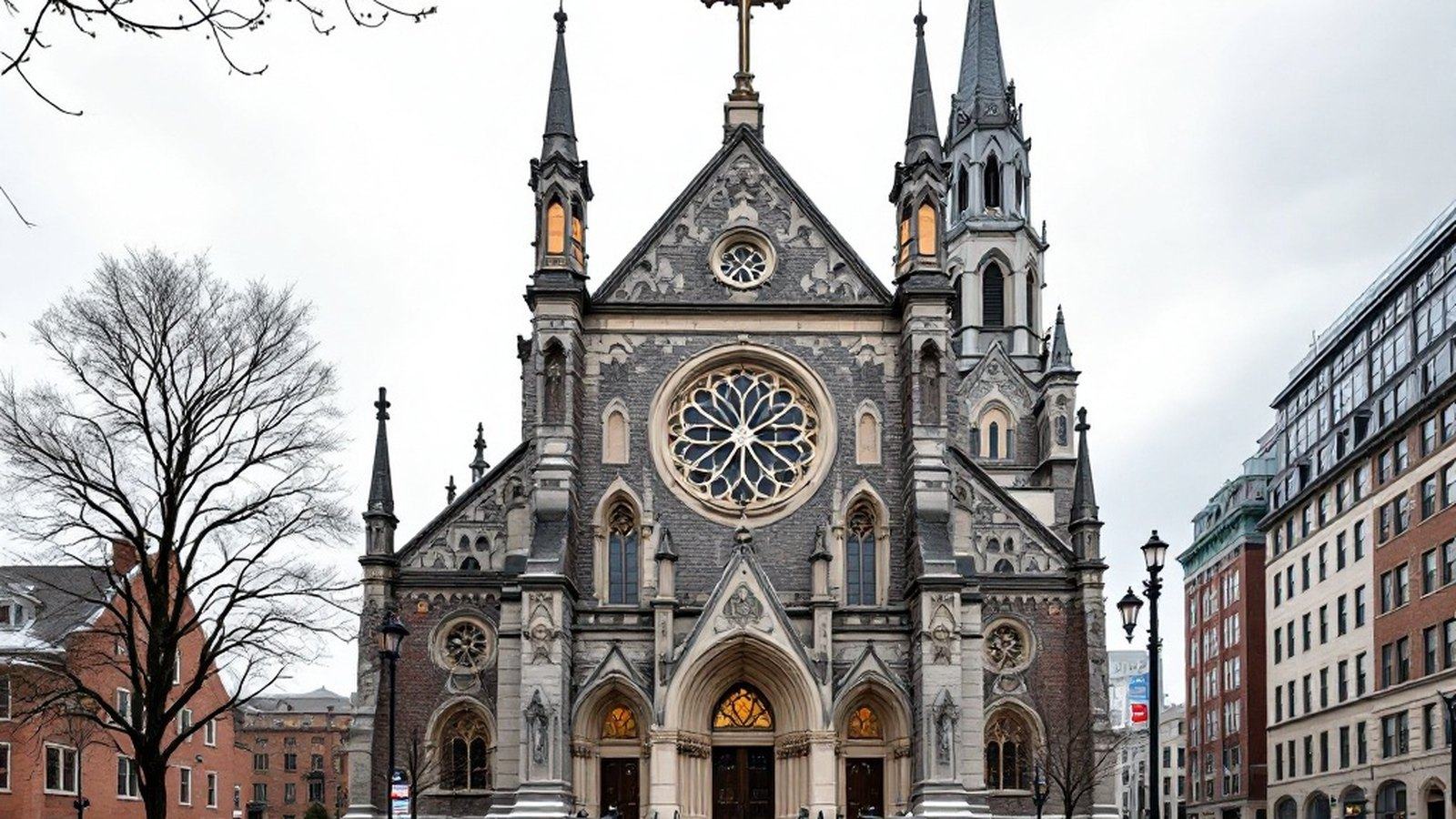
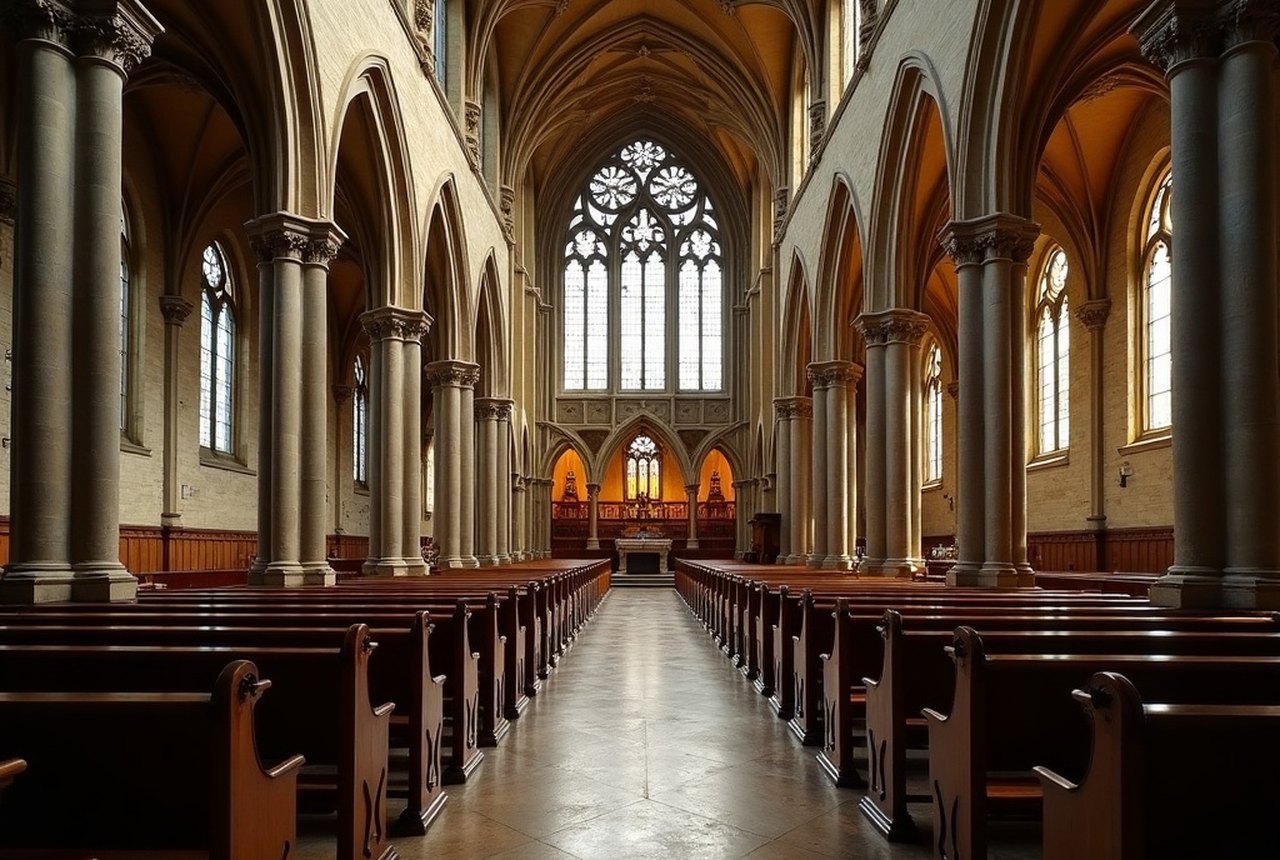
The Cathedral of the Holy Cross in Boston's South End is his masterwork in the state — and one of the largest Gothic Revival churches in the country. Construction began in 1867 under Archbishop Williams, and the building's sheer scale communicated something the Irish parish community wanted the city to understand: that Boston's Catholics were neither marginal nor temporary. The cathedral's long nave, its clustered piers, its lancet windows and soaring clerestory together compose a serious work of Gothic Revival architecture, one that Keely executed in Roxbury puddingstone and granite at a moment when the immigrant community that funded it could scarcely afford to. Pennies collected at Sunday Mass, week after week, raised a building worthy of a European archdiocese.
Keely's smaller parish churches across the city follow the same logic in miniature. The Gothic pointed arch became a kind of signature in brick and stone, repeated across Irish neighborhoods from East Boston to Charlestown — each building a landmark that oriented daily life around the parish rather than the street grid.
St. Stephen's and the Layered Record
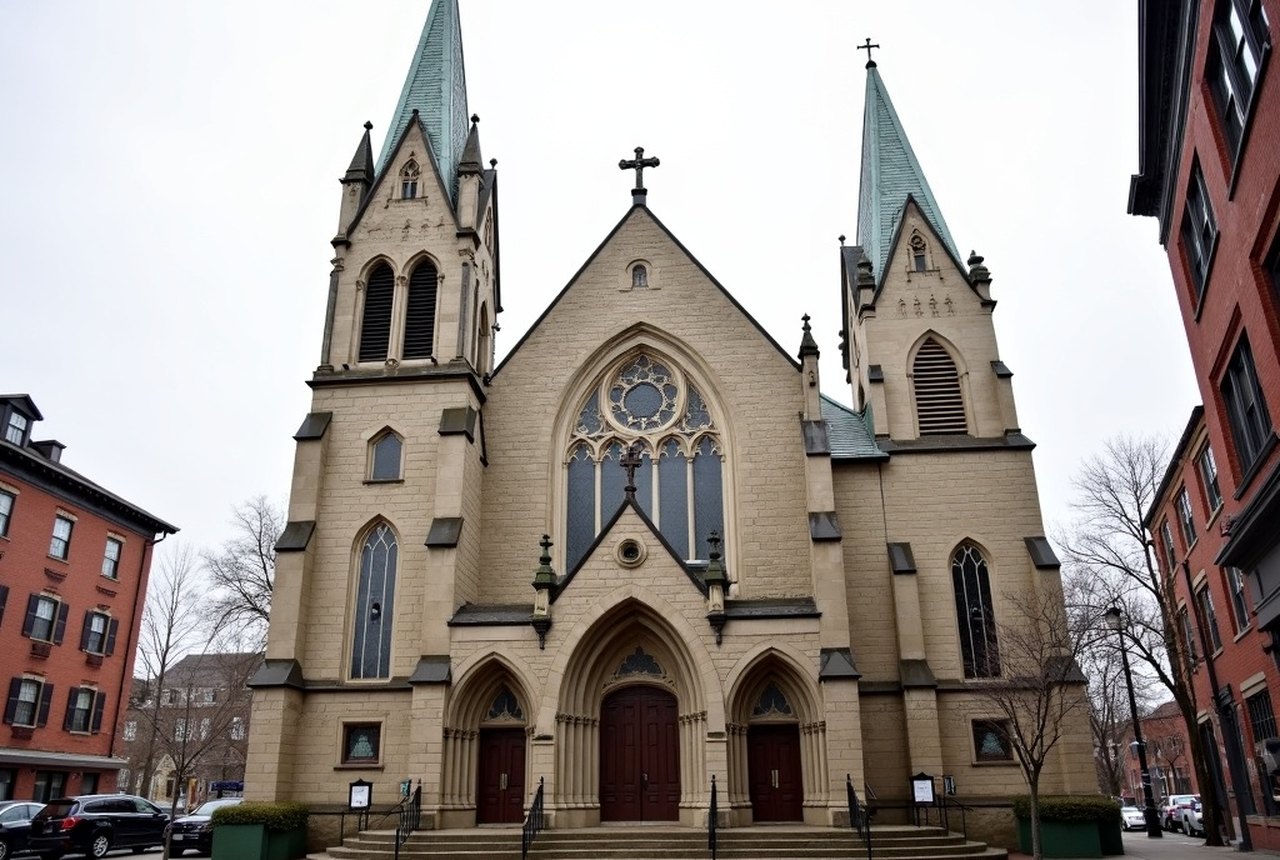
Not every church in Boston's Irish landscape was built by Irish hands. St. Stephen's Church in the North End tells a different kind of story. Originally designed by Charles Bulfinch in 1804 as a Congregationalist meetinghouse, it was purchased by the Roman Catholic Archdiocese of Boston in 1862 as the North End's Irish population swelled. The building was substantially altered over subsequent decades, then later restored — by Cardinal Cushing in 1965, and again more carefully thereafter — to something closer to Bulfinch's original intentions. Its history encodes the transfer of neighborhood power from Yankee Protestant Boston to immigrant Catholic Boston as legibly as any document.
The story it tells is not simply one of replacement but of adaptation: a community taking hold of what existed and making it theirs, layer by layer, generation by generation.
The Cathedral of the Holy Cross in Boston's South End is his masterwork in the state — and one of the largest Gothic Revival churches in the country
Stone as Argument
What the Irish parish builders understood, perhaps instinctively, was that architecture makes arguments that outlast the people who commission it. The famine generation could not vote in large numbers, could not hold civic office, could not count on the city's newspapers or institutions to reflect their presence. But they could build. And they did — in stone and brick, in pointed arches and bell towers and stained glass windows — creating a built landscape that insisted on their dignity long after the builders themselves were gone.
Walk the South End today, or the North End, or East Boston, and the argument is still being made. The churches are still standing.
- late 1840s–early 1850smass Irish famine arrivals into Boston
- 1804Bulfinch designs what becomes St. Stephen's
- 1862Archdiocese acquires St. Stephen's as North End Irish population grows
- 1867Cathedral of the Holy Cross construction begins under Archbishop Williams
Walk the South End today, or the North End, or East Boston, and the argument is still being made