
Catholic Charities of the Archdiocese of Boston
Catholic summer camps rarely make headlines, but the programs running quietly each season across Massachusetts and New Hampshire represent something genuinely worth attention: structured, faith-grounded environments where young people can build confidence away from the pressures of home and neighborhood. Two programs stand out for their depth, track record, and the communities they serve.
Catholic Charities of the Archdiocese of Boston is one of the largest social-service networks in Eastern Massachusetts, with more than a century of service behind it. Today it operates roughly 90 programs across 27 locations — from Brockton and Boston to Lawrence and Natick — spanning food assistance, immigration services, housing support, and youth development. Its summer programming sits within that broader mission, targeting young people who face real barriers: gang exposure, limited family support, interrupted schooling. The response is not simply a camp bus and a permission slip. Catholic Charities wraps its summer work in mentoring, tutoring, and structured leadership development aimed at strengthening school engagement and, more fundamentally, a young person's sense of their own capability.
That combination — social service depth and summer programming — makes Catholic Charities unusual among camp sponsors. Most organizations do one or the other. Here the summer experience is a concentrated version of the year-round relationship the organization builds with youth across Eastern Massachusetts.
Camps Bernadette and Fatima
The camps themselves are in New Hampshire, which surprises some Massachusetts families encountering them for the first time. Camp Bernadette, for girls, sits on Lake Wentworth, roughly twenty miles from New Hampshire's White Mountains — wooded, quiet, and genuinely removed from city life. Camp Fatima, for boys, occupies a site on Upper Suncook Lake, about a half-hour's drive away. The geographic separation is practical, not philosophical: the two camps operate as a single community in most ways that matter.
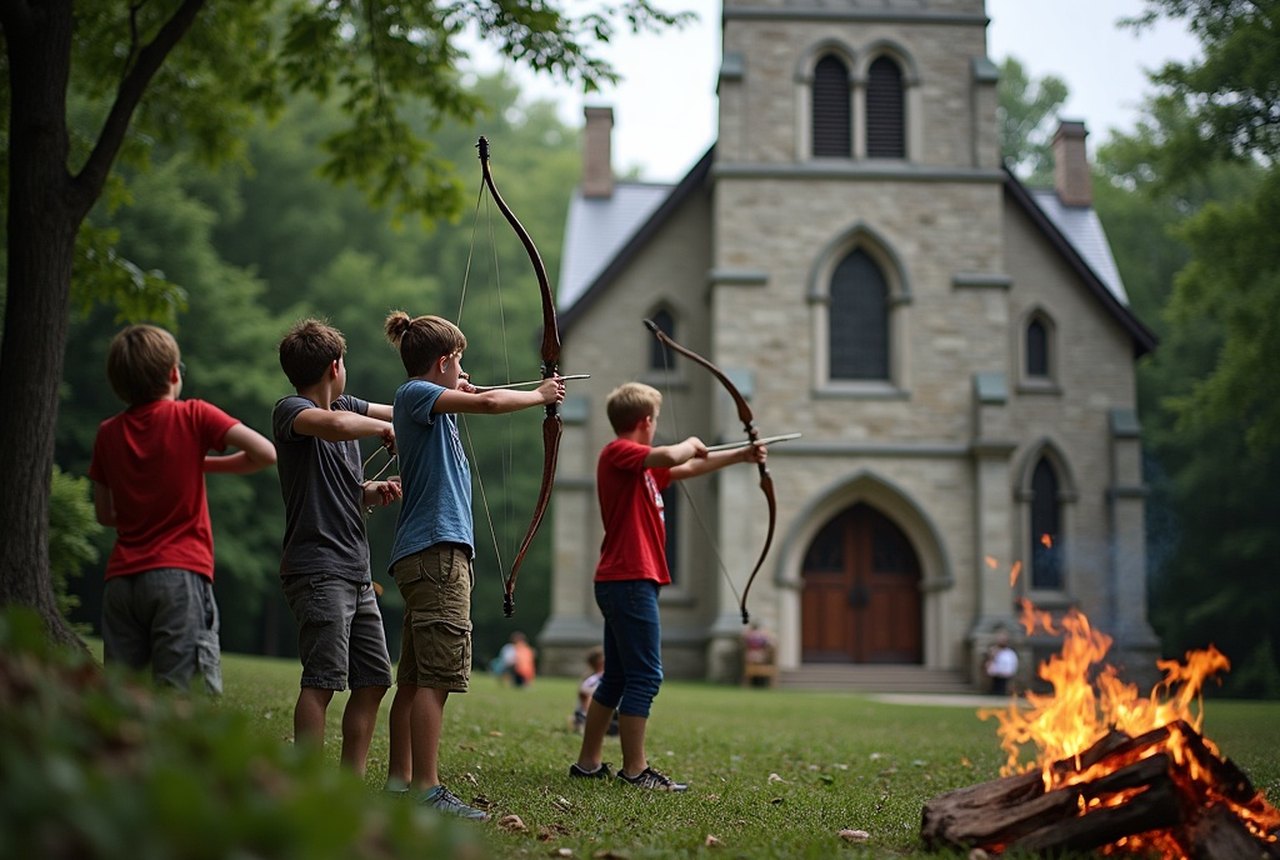
Campers from Bernadette and Fatima regularly come together for joint events, shared activities, and the kind of broader social experience that a single-site program cannot easily replicate. That integration is deliberate. The camps share resources and leadership, and the programming calendar reflects a considered attempt to balance structured activity with genuine freedom. Archery, rock climbing, canoeing, fishing, and arts and crafts all appear on the roster — a range wide enough that most campers will find something that genuinely engages them and, with any luck, something that pushes them slightly beyond their comfort zone.
Faith is woven through daily life at both camps, but the approach is worth noting: voluntary rather than coercive, ambient rather than didactic. Catholic identity organizes the community and provides its underlying ethic without reducing every afternoon to a classroom. For families already practicing, that framework is reassuring. For families less observant, it tends to read as the kind of values-based environment — respect, service, responsibility — they were already hoping to find.
Counselor selection reflects the same priorities. The camps look for adults who bring genuine energy to the work and a real investment in each camper's growth, not simply warm bodies filling supervisory roles. That standard matters more than it might sound: in a residential camp setting, the quality of counselor relationships is often what campers carry home long after the ropes course and the campfire songs have faded.
A Note on Visiting
Neither camp is a heritage landmark in the architectural sense — they won't appear in a guide to Romanesque stonework or Victorian stained glass. But they belong in any honest account of how the Catholic Archdiocese of Boston has shaped Massachusetts life across generations. The same institution that built the Cathedral of the Holy Cross in the South End and supported parishes from the North End to Chestnut Hill also built summer communities in the New Hampshire woods, extending its reach beyond the city and its mission beyond the Sunday liturgy.
For Massachusetts families exploring the full geography of Catholic life in the region — its buildings, its history, and its living institutions — Camps Bernadette and Fatima offer a piece of that picture that the stained glass guides tend to leave out.
That combination — social service depth and summer programming — makes Catholic Charities unusual among camp sponsors
The geographic separation is practical, not philosophical: the two camps operate as a single community in most ways that matter