A City Built on Parishes
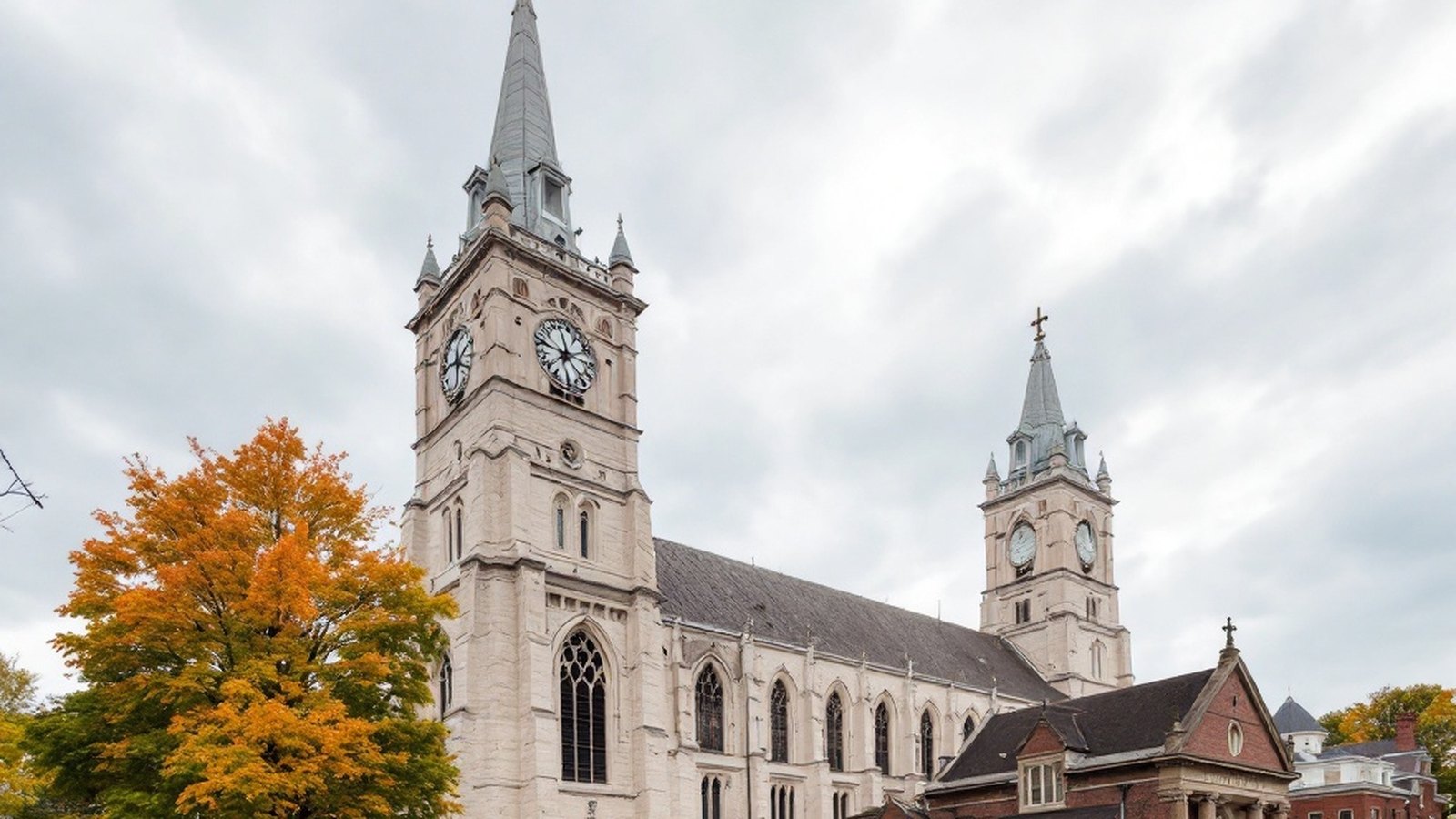
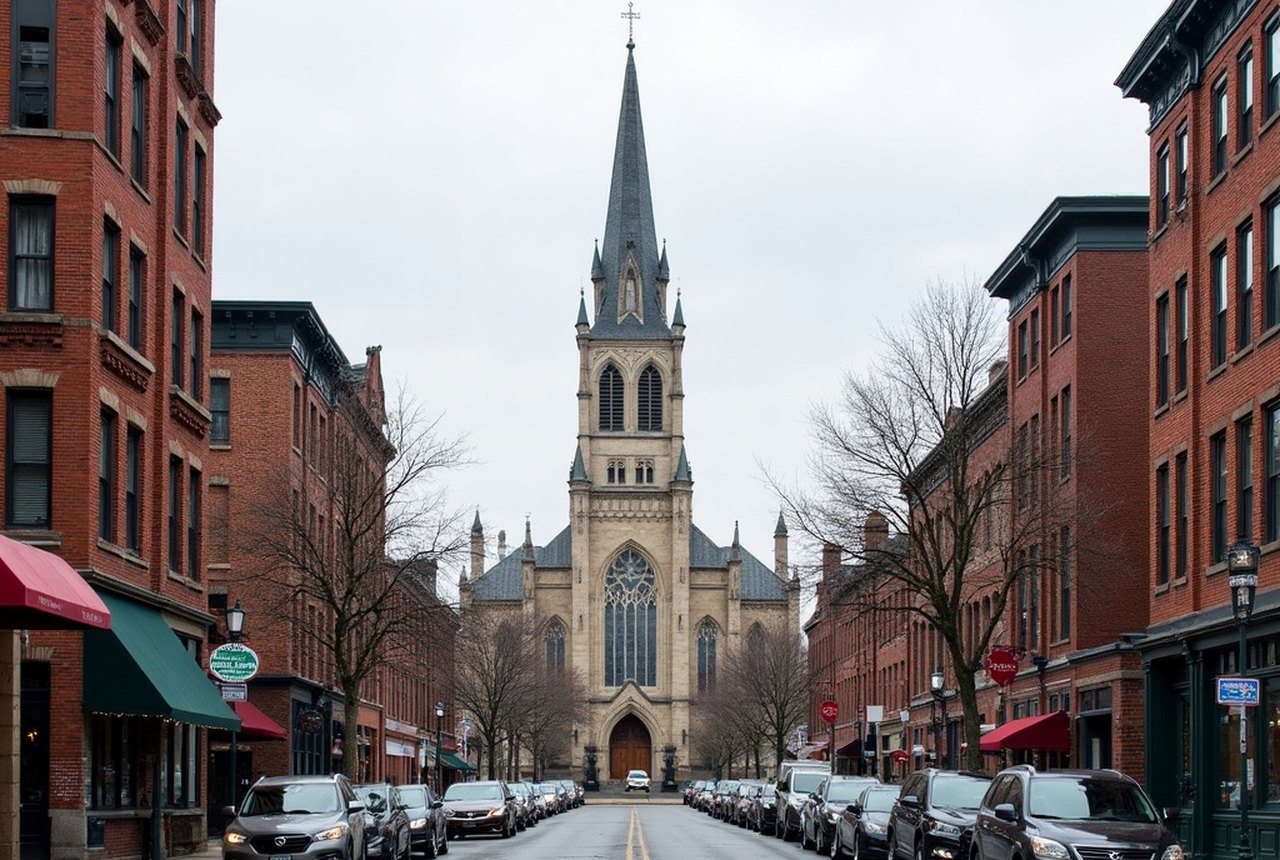
Worcester grew fast and rough in the nineteenth century — textile mills, wire factories, and railroads drawing wave after wave of workers from Ireland, Sweden, Poland, Lithuania, France-Canada, and Italy. Each community arrived, found a street corner, and built a church. The result is a city whose neighbourhoods are still legible, block by block, through their steeples.
The Irish came first and in greatest numbers. Their landmark is St. Paul's Cathedral on Chandler Street — not to be confused with its Boston namesake, though both serve as cathedral churches of their respective dioceses. Worcester's Holy Cross, a Gothic Revival structure of Milford pink granite completed in the 1880s, seats well over a thousand and anchors the Diocese of Worcester, established in 1950 when Rome carved the territory from the Diocese of Springfield. The cathedral's broad nave, lancet windows, and clustered piers place it firmly in the tradition of Patrick Charles Keely, the prolific Irish-born architect who designed more Catholic churches in New England than any other single hand — and whose influence is unmistakable in the building's confident verticality.
Street by Street, Spire by Spire
Walk east from the cathedral into the old Grafton Hill neighbourhood and the streetscape shifts. Polish Worcester built St. Casimir's on Ward Street, its twin towers a declaration of permanence from a community that arrived largely to work the wire and envelope factories. The interior retains Polish-language inscriptions and figural windows whose iconography — the Black Madonna prominent among them — signals a transatlantic loyalty that went well beyond the liturgy. A few blocks away, Lithuanian immigrants established a parish church of their own; its façade is weathered, but the community's connections remain traceable in the parish registers.
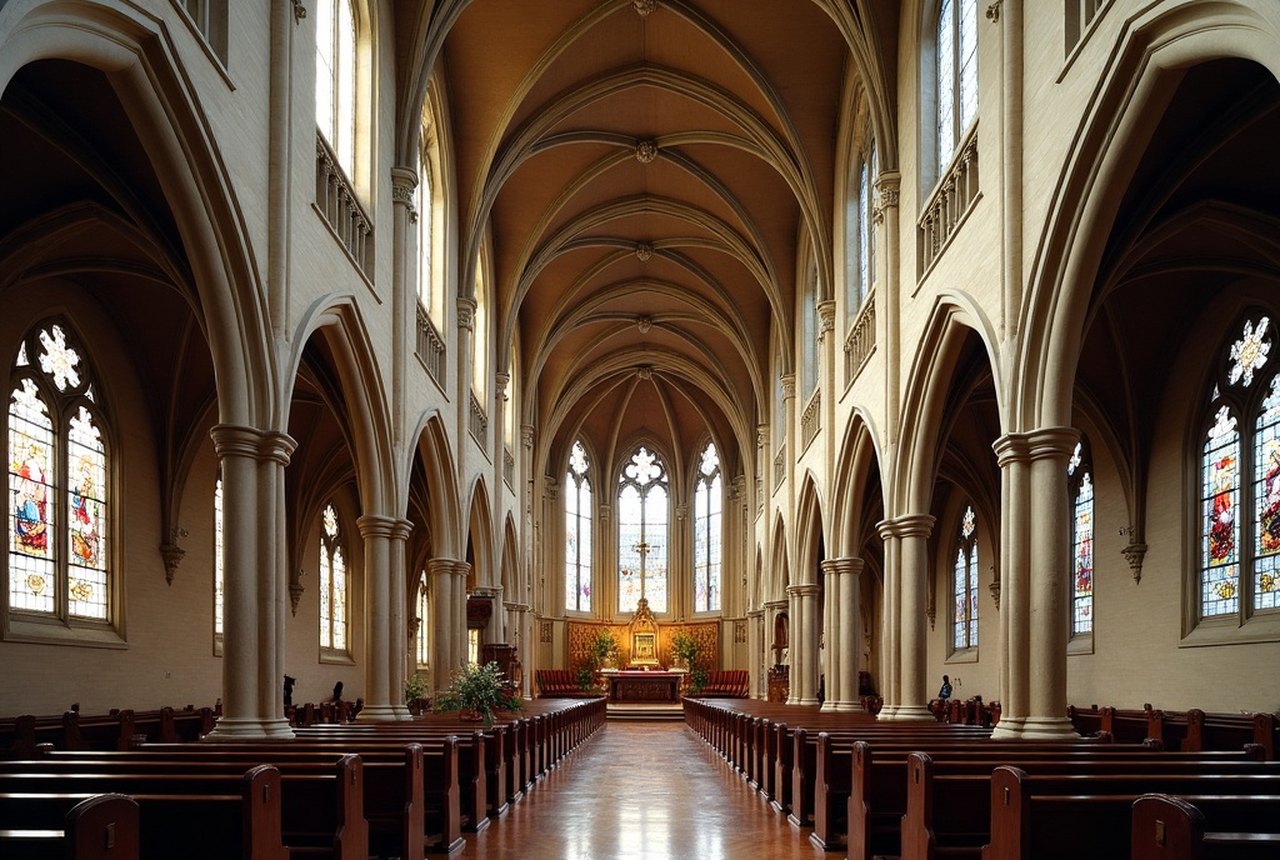
Head north toward Main Street and the French-Canadian presence asserts itself. Notre Dame des Canadiens, tucked just off Main, is arguably Worcester's most arresting surprise: a scaled stone church whose interior opens into a soaring barrel-vaulted nave with polychrome decorative painting of unusual ambition for a mill-city parish. Completed in the 1920s, it bears the imprint of a community that consciously modeled its institutions on the great Québécois churches back home, bringing skilled craftsmen to execute plasterwork and stencilling that would not embarrass a Montreal boulevard. The building is listed on the National Register of Historic Places — a recognition that its architectural ambitions have outlasted the francophone community that raised it.
The Italian quarter concentrated around Shrewsbury Street, now better known for its restaurant row, produced Sacred Heart Church, whose campanile remains a neighbourhood landmark. Here the Romanesque Revival vocabulary — round arches, rough-cut granite, a tower designed to be read from a distance — did double duty as ethnic pride and civic assertion. The sons of the congregation paid pew rents and funded the windows themselves, a practice that embedded family names in the glass and made the interior a kind of collective portrait of the immigrant generation.
Hills, Mills, and the Long View
Worcester's topography — a city of genuine hills — meant that churches were often sited for visibility as much as convenience. The Jesuits at Holy Cross College on the city's west side anchored their campus with a church whose institutional gravity shaped the whole surrounding neighbourhood; the college's Catholic identity has long been inseparable from the hill it occupies. Across the city, the Dominicans, the Oblates, and various diocesan parishes each carved a territorial claim, so that a detailed map of Worcester's Catholic plant reads almost like a census of nineteenth- and early-twentieth-century immigration itself.
What survives is uneven. Several parishes have closed or merged under the consolidations that have reshaped New England Catholicism since the early 2000s, and some fine buildings have been repurposed or are at risk. But the fabric holds. The granite is durable, the stained glass mostly intact, and the streetscapes of Grafton Hill, Shrewsbury Street, and the Main South neighbourhood retain enough of their ecclesiastical topography that the original city — parish by parish, community by community — remains readable to anyone willing to look up.
The result is a city whose neighbourhoods are still legible, block by block, through their steeples
- 1880sCathedral of the Holy Cross completed in Milford pink granite
- 1920sNotre Dame des Canadiens completed with barrel-vaulted polychrome interior
- 1950Diocese of Worcester established by Rome
- early 2000sparish consolidations begin reshaping New England Catholic landscape
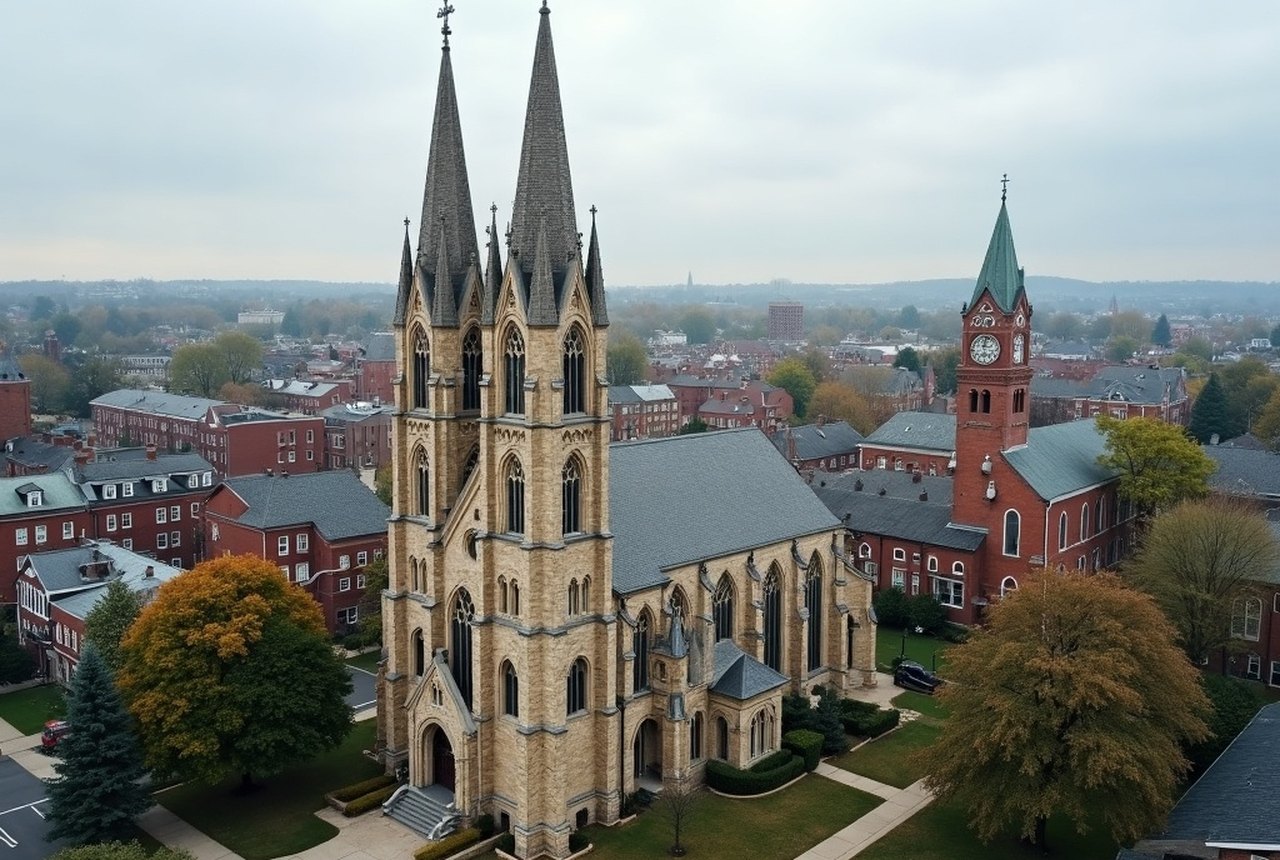
Worcester's topography — a city of genuine hills — meant that churches were often sited for visibility as much as convenience