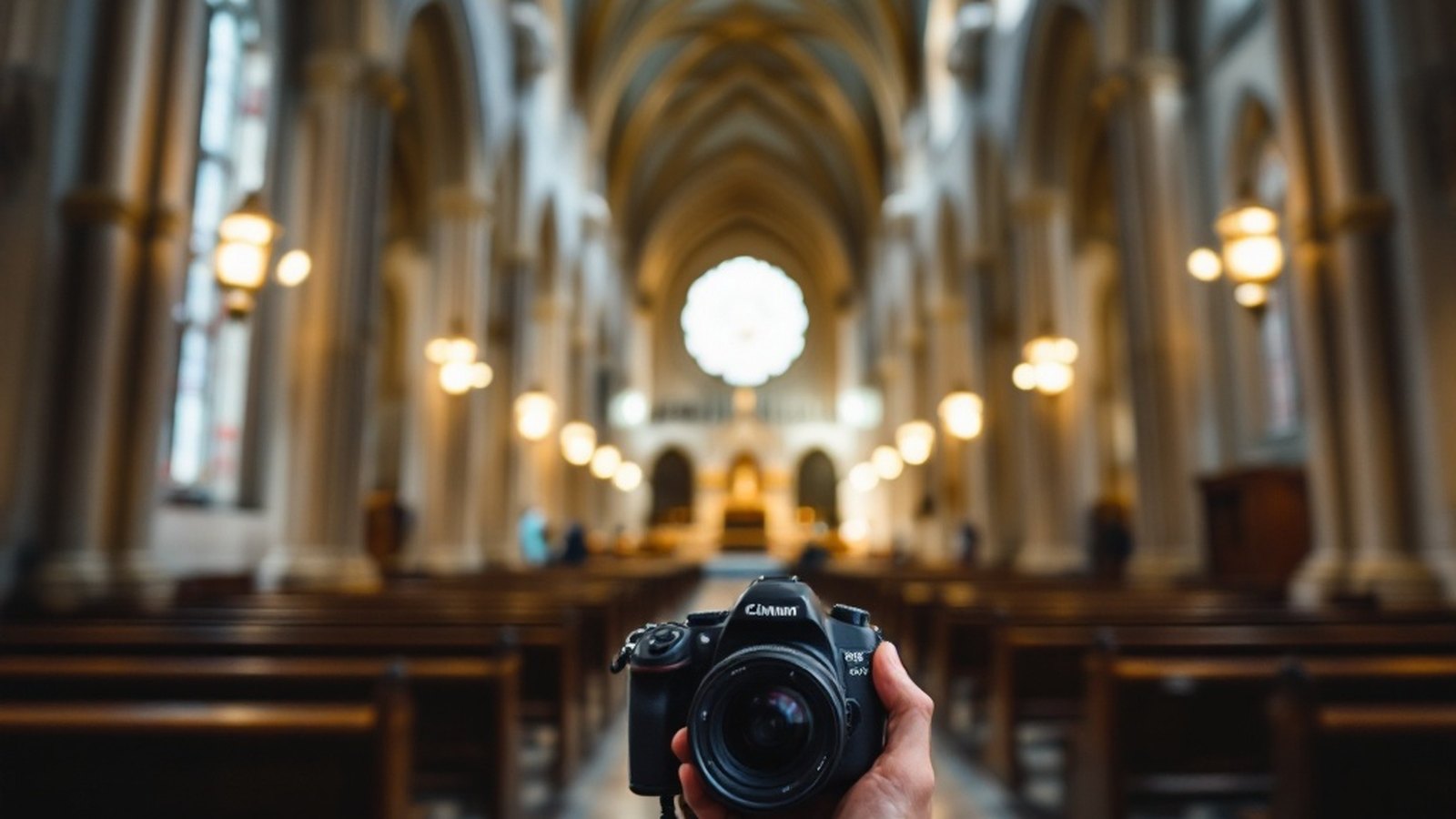
Know Before You Shoot
Permission is the non-negotiable first step. Most Catholic parishes in Massachusetts welcome respectful photographers, but that welcome is not assumed — it is earned. Call or email the parish office in advance; explain you are documenting the architecture, not conducting a commercial shoot. Many churches, including places as visited as Trinity Church in Copley Square or the Basilica of Our Lady of Perpetual Help on Mission Hill, have specific photography policies, and arriving already knowing them saves everyone time.
Never photograph during Mass or any active liturgy. Even a mirrorless camera is a distraction; a flash is an intrusion. If you arrive and a service has started, wait — the light after morning Mass, when the congregation has left and the nave settles into quiet, is often exactly what you wanted anyway.
Reading the Light
Church interiors are exercises in patience. Stained glass reads best on an overcast day, when diffuse sky light pushes through the colored panes evenly without the blown-out patches that direct sun creates. Clerestory windows in a tall Gothic Revival nave like the Cathedral of the Holy Cross in the South End pour oblique morning light down the clustered piers in ways that shift dramatically within an hour — arrive early and work quickly.
Bring a compact tripod or a monopod if policy allows. High ISO performance on modern cameras has improved enormously, but the long exposures possible with a stable base preserve shadow detail in dark side-chapels and apses that no amount of digital noise reduction can recover afterward. Turn off auto white-balance and set a custom kelvin value on-site: the mix of warm incandescent fixtures and cool window light will otherwise give you muddy, indeterminate color across a single frame.
Wide-angle lenses emphasize the verticality that builders labored over; a tilt-shift lens, if you own one, corrects converging verticals without post-processing gymnastics. For detail work — a carved capital, a mosaic lunette, a section of ornamental stonework — a moderate telephoto from the back of the nave is often more honest than climbing close and distorting the subject.

Leaving It as You Found It
Move nothing. Touch nothing. If you shift a kneeler for a cleaner composition, put it back. Decline to cross into sanctuary areas unless specifically invited. And if your published work prompts readers to visit, you have repaid the welcome with something genuinely useful — more eyes on the built heritage that these communities have spent generations maintaining.
Most Catholic parishes in Massachusetts welcome respectful photographers, but that welcome is not assumed — it is earned
